What is Tryptophan-Like Fluorescence?
The molecule. Tryptophan is an essential aromatic amino acid—humans and animals cannot synthesize it and must obtain it through diet. Its distinctive indole side chain makes it intrinsically fluorescent: illuminated with ultraviolet light at approximately 275 nm, tryptophan re-emits at approximately 340 nm. Tryptophan-like fluorescence (TLF) is the optical water quality parameter that captures this signature, along with the closely related fluorescence of tryptophan-containing peptides and proteins.
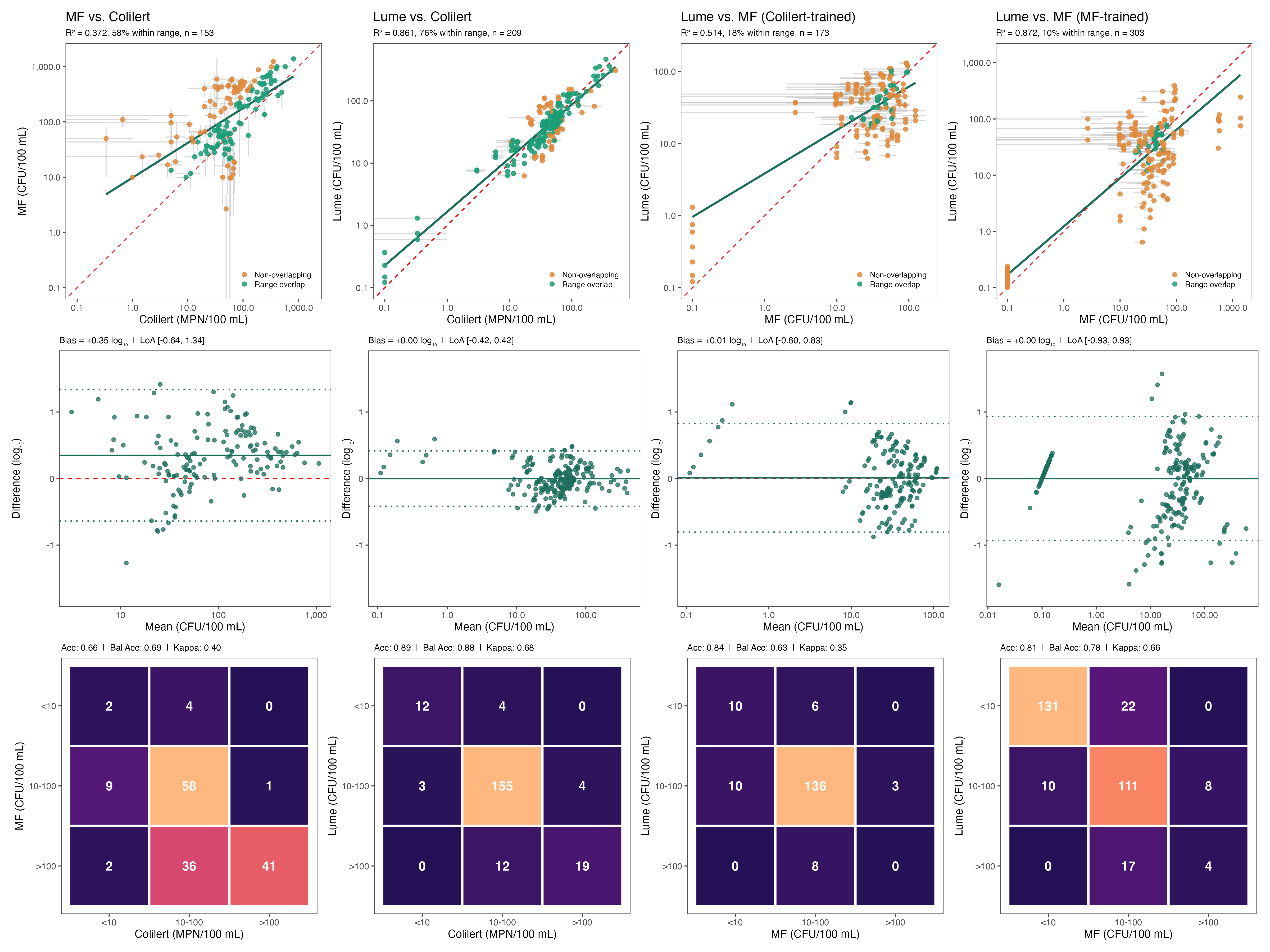
Direct measurement, not a proxy. At the physics level, TLF is not a proxy for anything—it is a direct optical measurement of the concentration of free tryptophan, small tryptophan-containing peptides, and exposed tryptophan residues on protein surfaces in the water column. That dissolved-protein pool is itself a near-direct measure of fresh microbial biomass: free tryptophan in surface water has a half-life of days and is dominated by recent cell lysate and active microbial secretion. TLF therefore directly measures recent proteinaceous biomass loading—a fundamental water quality parameter on its own, independent of any particular species. E. coli culture counts and TLF are best understood as co-measurements of the same underlying biological reality, not as ground truth and proxy. The Lume is calibrated against CFU/100 mL because CFU is the regulatory unit, not because CFU is the more fundamental quantity; in continuous deployments TLF actually integrates total fluorescent biomass in real time, while culture-based methods sample one indicator species at a single timepoint.
Why TLF tracks E. coli. Tryptophan in water correlates strongly with E. coli for two compounding reasons. First, both share a common origin in fecal contamination: every bacterial cell is built from protein (roughly 1% of amino acid residues are tryptophan), and feces is rich in free tryptophan, tryptophan-containing peptides, and live enteric bacteria. Wherever one is elevated, the other tends to be as well. Second, E. coli uniquely expresses the enzyme tryptophanase (encoded by the tnaA gene), which cleaves tryptophan into indole, pyruvate, and ammonia—a defining metabolic trait that has been the basis of the classical Indole Test for E. coli identification for over a century. Both tryptophan and E. coli also degrade on similar timescales in the environment, so an elevated TLF signal flags recent, biologically active contamination rather than legacy organic matter.
Why fecal sources dominate the signal. Not all bacteria or organic matter contribute equally to TLF. Enteric bacteria produce tryptophan-rich outer-membrane proteins, pili, and flagellar proteins, and lyse rapidly when they leave the gut, releasing free tryptophan and small, highly fluorescent peptides into the water. Fecal plumes deliver this material at 106–108 cells per mL—orders of magnitude above the slow turnover of native environmental bacteria, which tend to be sparse, oligotrophic, and far less protein-rich per unit volume. Meanwhile, the dominant non-fecal organics in natural waters—humic and fulvic acids from soil and plant decay—fluoresce in a different region of the excitation/emission matrix (humic-like fluorescence, ~340/440 nm) and contribute little to the tryptophan channel (~275/340 nm). The combination of high-flux, tryptophan-rich biomass from feces and a chemically distinct humic background is what lets TLF act as a relatively specific marker for recent fecal contamination rather than general organic loading.
A validated real-time proxy. A positive relationship between TLF intensity and fecal indicator bacteria (FIB), particularly E. coli, has been demonstrated across groundwater, surface water, estuarine, and urban watershed contexts on multiple continents. Because TLF is a purely optical measurement—no reagents, no incubation—it delivers contamination signals in seconds rather than the 24–48 hours required by culture-based methods. The Lume builds on this foundation by coupling TLF optics with machine learning that corrects for the environmental confounders (turbidity, temperature, dissolved organic carbon) that limit static-threshold approaches.